|
Remember before you begin any dowsing to check your permissions - see
tip 2 if you are unsure
Dowsing Tip Number Six
When dowsing for
gold and precious minerals remotely or on site it can be difficult
as the gold seems to throw out false images of itself which makes
it extremely difficult and the problem is the false image of the
gold stays on the rock for at least one hour before it starts to
fade away so the point is that you can dowse some rocks, check the
rock beneath your feet and it can indicate there is gold in that
piece of rock and an hour later once you have taken it away to a
different location and tested it again then it reacts as if there
is no gold in the rock which is heart breaking to say the least.
It is not easy to override these false images which occur when you
are dowsing for the gold but by using gold itself and visualising
the gold and at the same time saying to yourself “ignore all false
images just react to the gold” this will help to increase the
success rate. You can never get 100% success rate when working
with solid minerals but I find by using this method it does help
to improve the success rate.
Dowsing Tip Number Five
Tips that can
help you
- Make sure
you are positive and not negative when on site
- Wet your
hands before and during the process of dowsing to improve
sensitivity
Problems to
Watch Out For
CLAY
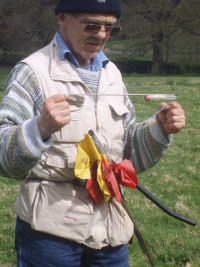 Most
dowsers find it difficult to work with clay as it tends to throw
the depth count out. I found I could overcome this problem by
adding 20% to the depth count when dealing with clay - with one
exception, which is 'Marley clay'. With this type of clay I have
found that I must double my depth count. This may be different
for other dowsers. Most
dowsers find it difficult to work with clay as it tends to throw
the depth count out. I found I could overcome this problem by
adding 20% to the depth count when dealing with clay - with one
exception, which is 'Marley clay'. With this type of clay I have
found that I must double my depth count. This may be different
for other dowsers.
KEEPING AN OPEN
MIND WHEN APPROACHING A SITE
I have found it
is important to clear your mind of everything and just
concentrate on the source of water that you seek. You must
ignore what other people might say of infer about the site as it
could cause confusion and deflect you from the true source of
water.
REACTION LINES
As you may know
there are seven reaction lines to each flow system. Six of
these will move and never stay the same. The one you need to
look for is the one which remains stationary all the time. It is
advisable when learning to dowse that when you approach a source
of water you peg out the reaction lines that you are getting.
Once that has been completed, wait 2 to 3 hours then repeat your
checks on your markers. You will notice the first three would
have moved either inwards or outwards; the fourth one will
remain the same, which is the flow. The three on the other
side will also have moved forwards or backwards. Twenty eight
markers would be needed. With a lot of experience you can
eliminate the reaction lines and go straight to the source.
OVER-CONFIDENCE
I have learned
to treat every site/location with caution. It is important never
to get over-confident or complacent. Treat each site as if it
was your first.
Dowsing Tip Number Four
Before you start
to dowse always ask the question 'am I positive or negative'? If
you are negative leave it for a short while and try again later.
Sometimes you can be positive when you start dowsing, and before
you complete the job you have become negative. I suggest you
approach it by asking are you positive before you start, and
periodically through the dowsing keep checking yourself. The
problem is, you don't know when you become negative. This is why
you have to regularly check, otherwise you get false results, and
the job will be a failure. You must be positive at all times when
dowsing either on site or when map dowsing'
Dowsing Tip Number Three
Just for fun.
This is an
exercise that I enjoyed trying out over 26 years ago, and whether
you are new to dowsing or have been practicing for some while, I'm
sure you'll get fun out of this too.
You will need
a very large sheet of paper - such as the sheets you get from
flipcharts. You may need to sellotape several sheets of A3 paper
together. Then get out your local map and draw a section of a
local river or stream onto the paper. Draw it nice and big. The
idea is to have a plan large enough that you can actually step
onto the paper and walk across the 'river'.
Now prepare
yourself just as you would for any water dowsing job. Ask for
permission. The time tested 'Can I?' 'May I?' 'Should I?' (Be
aware that if you get a 'no' to any of these do not continue)
Now hold a
clear picture in your mind of the water flowing through a stream,
some people find it helps to run their hands under water
immediately before the dowsing, or to hold a small bottle of water
in their hand (this is called using a witness).
Turn the paper
face down so that you can not see the river. Now with your rods in
the search position walk across the paper, you will get no
reaction.
Now turn the
paper over so that the plan of the river can be seen, and approach
the river at right angles, just as you would if you were going to
step over it in 'real life'. As you cross the river, your rods
will indicate water.
|
Free Dowsing Tips
straight into your inbox.
Just fill in your
email here
I promise your email address
will not be shared with anyone else, for any purpose |
|
When I first
tried this out, my young daughter was amazed at the reaction
she got from the rods, and so was I! This exercise is an
aspect of what dowsers call 'map dowsing', that is - getting a
reaction from a plan or a map as if you were actually at that
spot in real life.
You can
also try this by drawing a approx plan of your house, drawing
in any water pipes. Again remember to prepare yourself by
asking for permissions and using a witness if you wish. Hold a
clear image in your mind of the water flowing through the
pipe, and see if you get a reaction.
You can of
course also use a hosepipe in the back garden with the water
running through it, and as you step over it you will get a
reaction with your rods.
Have fun
Peter
|
Dowsing Tip Number Two - Permissions
This is not so
much a tip as just making sure that you know how to approach any
dowsing you do. It is advisable to always ask for permission
before you start a dowsing session.
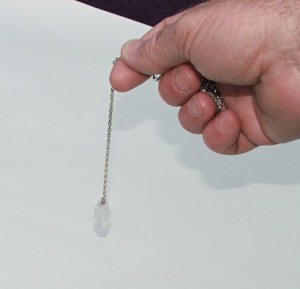
Most
dowsers have a little routine that they follow before they begin a
dowsing job, it goes something like this.
Lets say
for argument sake you are using a pendulum (though this would
apply equally to any other dowsing tool)
First check
your pendulum by asking it to show you a yes.
If you are new
to dowsing you may have to wait patiently for a while, you can
speed things up a little by setting the pendulum in a back and
forth swing. Eventually the pendulum will begin to make little
circles. Note which direction it is swinging - if it swings
anti-clockwise and you asked for a yes - then anti-clockwise means
yes.
Again if you
are new to dowsing you might want to confirm this for yourself by
asking yes questions - ie is my name ...., is it ...day today and
so on.
Now go
ahead and check your 'no'.
Having done
all this you are ready to ask your permissions. (Don't worry
if all this seems a bit long-winded - as you get more experienced
you'll already know how your pendulum shows a no and a yes.)
The standard
permissions are
'Can I do
this dowsing ' - that is am I capable at this moment in time
'May I do
this dowsing ' - that is do I have full permissions from
everyone involved
'Should I
do this dowsing ' - is it advisable for me at this time to
undertake this dowsing
Assuming
you get a yes to each question - you are free to proceed.
Should you get
a 'no' to any of them, then it is not advisable to proceed. It may
just be that you are too tired to get an accurate result and you
will be wasting your time, whatever the reason it is best to
respect the answer.
Dowsing Tip Number One
I want to start
with my most important dowsing tip. It something that is
applicable to all dowsers whether beginner or professional.
After any dowsing job remember to ground yourself.
Grounding is important as you have been using energies not yet
fully understood, and it is important to disconnect from them at the
end of each session.
How to ground yourself...
Grounding can be
simply done by rubbing your hands together and throwing the energy
back to earth and saying finished.
Or
join
your hands together at the top of your head and slowly bring them
down the front of your body until you touch the earth then undoing
your hands touch the earth and say grounded and finished.
With either of
these techniques; they should be repeated three times, four if you
want to be absolutely sure you are grounded.
These simple
actions need take only seconds to perform, so it is easy to make it
part of your dowsing routine.
I will be adding
more tips to this page, so please do
check back here. Alternatively if you'd like a sneak preview, sign
up to have the tip delivered straight to your inbox.
|